If I had to pick one shining example of a role model for anyone itching to get into the Great Outdoors more, Erin McKittrick would be the one. A molecular scientist, she grew up in Seattle and is now raising her family in Seldovia, Alaska. She and her partner Hig (and more recently, their two young children) have logged over 8,000 miles of wilderness travel. She is a steward of the earth, an incredible storyteller and I am so honored to have her here to share her story with you!
We all crow over a baby’s first steps. We celebrate our new walkers with video, with baby books, and with calls to the grandparents. Walking is a milestone in every parenting book.
But for an outdoor parent–a hiking parent, a snowshoeing parent, even a walking-to-the-grocery-store parent, those teetering steps on chubby bowed legs aren’t the important ones. The real transition to walking comes much later.
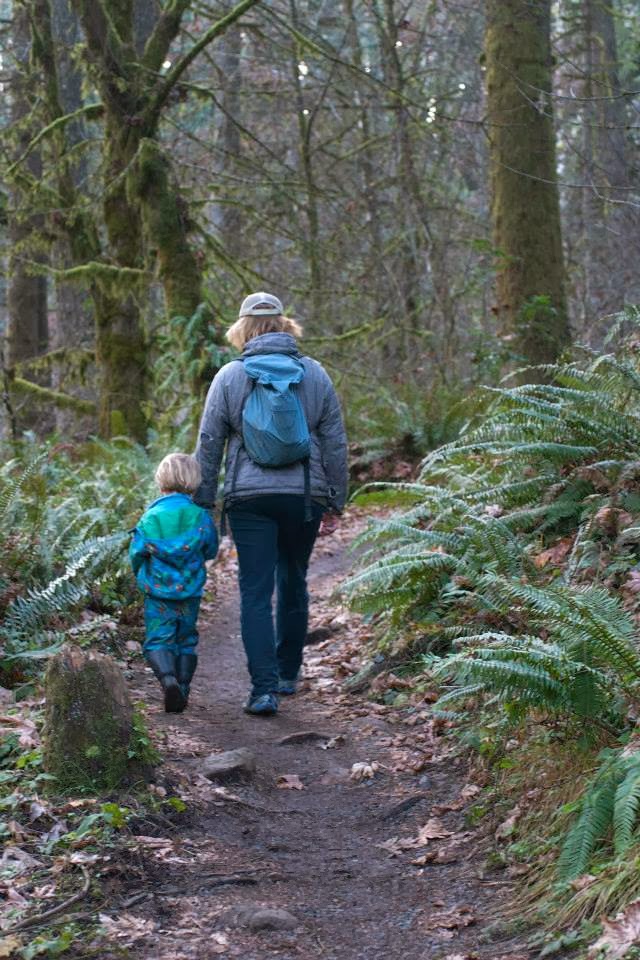
Last week, it came on a sunny November day in Eugene, Oregon, far from our usual Alaska haunts. I stepped aside, and stepped aside, and stepped aside again, as a steady stream of hikers zoomed past in both directions.
They paused, glancing at the tiny figure in turquoise–thigh-high to my own short frame.
“Wow, that’s a big hike!”
Near the steep upper end of the trail, passing hiking groups started teasing eachother as they climbed: “Look at that little kid! If she can do it, you can definitely do it.”
The little kid was my daughter–not quite three years old–holding my hand as she balanced on the wooden beams that lined the edge of the trail. The hike was Spencer’s Butte, a busy trail that climbed 700 feet to a scenic rocky knob, 3.5 miles along the path we followed.
The pace was crawling.
The rest of our hiking group quickly left us behind. My nearly-5 year old zoomed ahead with his dad and aunt. The other parents hurried to the top with their own young children in a backpack, shortcutting their way to the playing and rock-climbing that could happen at the top.
I understand. The temptation to carry her is overwhelming. It would be so much simpler, so much easier, so much faster. And of course, when she was little, I did just that.
But now she’s almost three. And it’s time to transition to walking.
I jog ahead a few paces, hiding behind a tree trunk on the side of the trail. She runs a few paces herself, then slows, peeks, laughs uproariously each time she finds me. Repeat, repeat, until hide-and-seek is replaced by sticks, then sound games, and exclamations over every passing dog…
Then: “I’m tired.” So I suggest a break, dropping into the dirt to sit beside her until she says she’s ready to go on. Later: “I want to go home.” So I point out that we’re in a forest–what a wonderful place to spend ten minutes playing airplane ride on fallen logs. More: “I’m tired.” I dole out dried apples for energy and a psychological boost, one slice for every twenty feet of progress.
There are more of these rough patches. Slowly, we move through every one of them, always returning to fun and games, or just to two people walking down the trail, hand-in-hand at toddler pace.
I coax, I play, I feed, I chat. I hold hands. I exercise every bit of patience I can muster, cheerfully and calmly enjoying the woods I’m snail-walking through. What I never do is doubt.
Kids can smell doubt. They can smell lack of parental resolve, and lack of parental confidence. Optimistically and stubbornly believing that a kid can do what seems unlikely is the biggest trick in my book.
So we did it. The whole hike, under her own power. My daughter didn’t notice. She spent the day walking and playing in the woods, happily indifferent to the view from the top, or the pride I felt about my not-quite-three-year-old hiking three and a half miles.
I joke with friends that I’m training her like I trained her big brother, and that I’ll cut her off from being carried once she hits three years old. But I’m really training myself. To keep getting out into the woods together, we all need to learn to walk. And all she needs to learn it is my patience, time, and as much confidence as I can project on her.
My kids both took their first steps a long time ago. But it’s these ones I’ll remember.
___________________________________________
About the Author




 Mommy Hiker